The Problem
The right starting point isn't cryptography. It's the network. Where does PII actually travel? Which segments of that path cross the internet and can be intercepted? Those are the segments where the quantum threat is real and where the organisation needs to act.
Where PII Flows
For most enterprise web applications, user PII travels through a common pattern: browser to CDN edge, then CDN to origin. TLS terminates at each of those two points. They're separate encrypted tunnels, not one end-to-end pipe. The organisation controls the configuration at both termination points. That matters for what comes next.
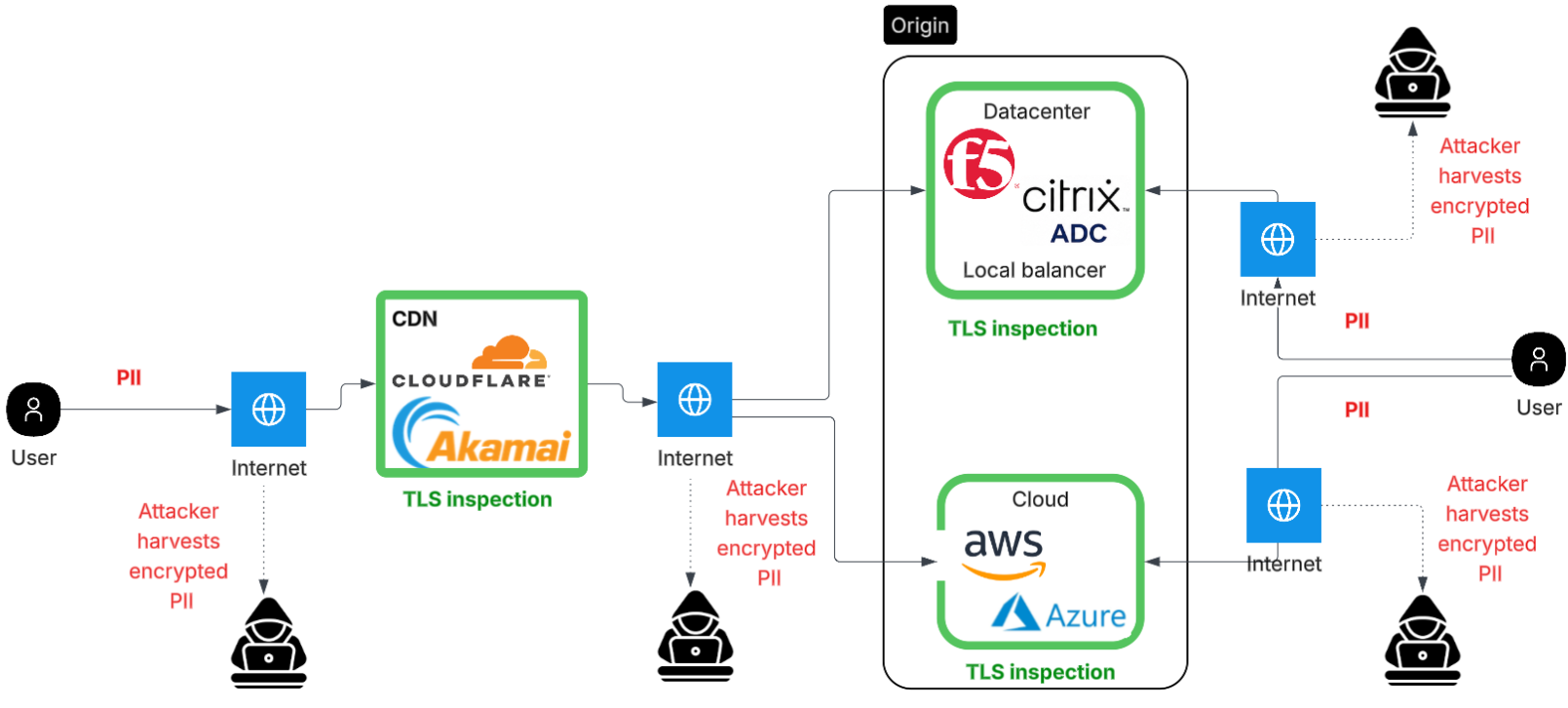
- Crosses the public internet. Harvestable by nation-state or ISP tap.
- Organisation controls CDN TLS config → PQC is achievable here
- Cloudflare: ML-KEM on by default for all TLS 1.3 zones
- May cross the internet (CDN PoP to origin datacenter)
- Organisation controls origin TLS config → PQC is achievable here
- F5 BIG-IP: ML-KEM available from TMOS 17.5.1+
Why the Key Exchange Step Is the Vulnerability
TLS does two separate things: it establishes a shared secret between client and server (key exchange), and it uses that secret to encrypt the actual data (AES-256). A quantum computer only threatens the first step. AES-256 isn't meaningfully affected.
Key Exchange
RSA and ECDH rely on mathematical problems that a sufficiently large quantum computer
can solve efficiently. This is the step where client and server agree on a shared secret
at the start of every TLS session.
Broken by quantum
Data Encryption
Once the shared secret is established, all application data (form submissions, API
responses, session tokens) is encrypted with AES-256. Quantum computers don't provide
a meaningful attack against AES-256 at current key lengths.
Not a quantum problem
Post-quantum cryptography replaces the key exchange algorithm only. The rest of TLS, the certificate, the cipher, the MAC. None of that changes. It's a targeted replacement, not a rebuild.
Harvest Now, Decrypt Later
Every post-quantum readiness conversation eventually lands on this phrase. It sounds like something from a sci-fi script, but the mechanics are straightforward and the first half is already happening. You do not need a quantum computer to start this attack. You only need one to finish it.
The reason this matters for your network today is that the capture step requires nothing special. Bulk interception of TLS traffic at internet scale is well within the capability of nation-state actors right now. The encrypted data sitting in cold storage somewhere is just waiting on the hardware.