Post-quantum readiness
for people who run networks
Post-quantum cryptography started showing up in vendor roadmaps and compliance conversations, and I realised I was nodding along without really understanding it. So I decided to learn it properly. Not just the theory, but how it applies to the kind of infrastructure most enterprise networks actually run.
This site documents what I found. Everything here has been tested and verified against a
standard enterprise stack: Cloudflare as the CDN edge, F5 BIG-IP as the origin load balancer,
and a real domain to run openssl s_client against. This is a common architecture:
CDN in front, load balancer at origin. Not specific to any one organisation.
Where Does PII Get Exposed, and Where Should We Focus?
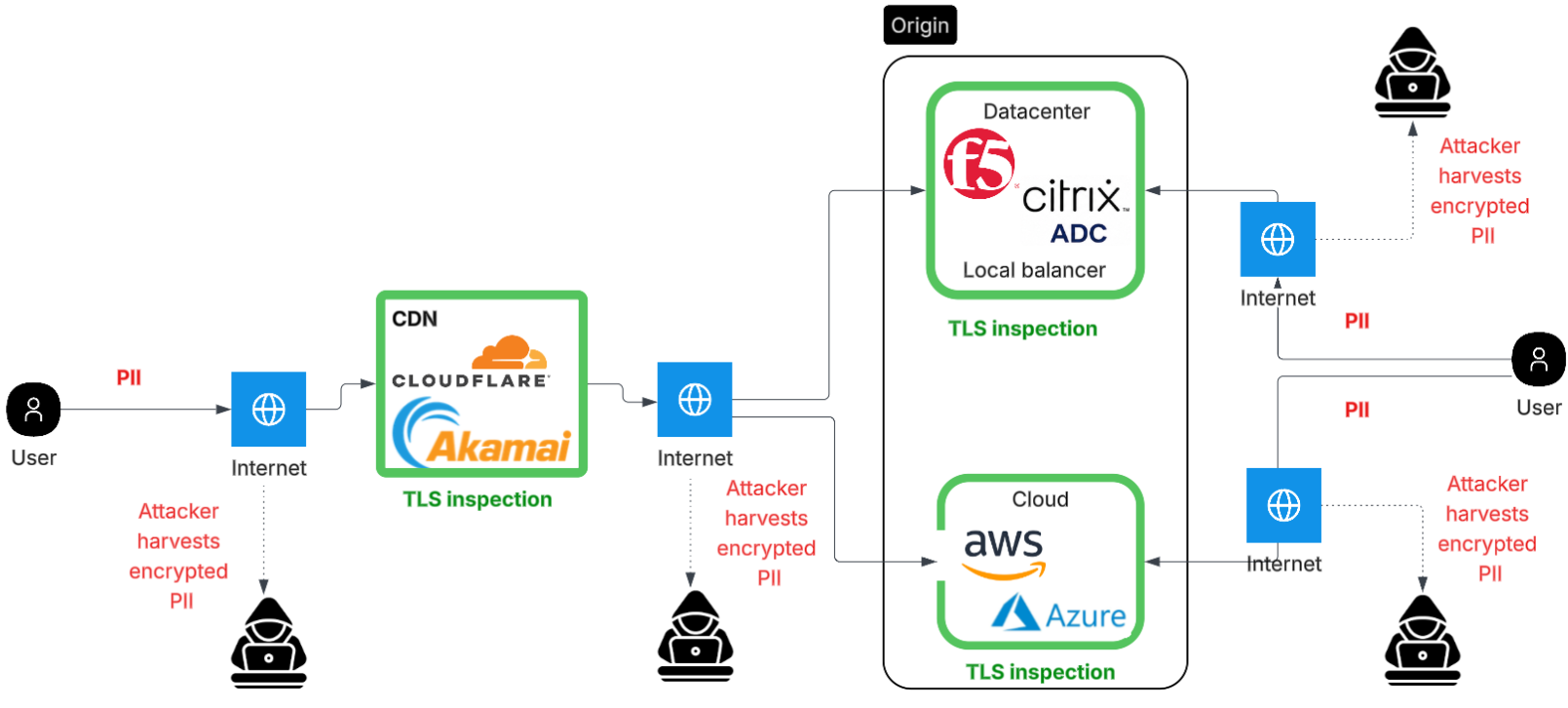
PII travels across two separate internet-exposed TLS legs before it reaches your application: browser to CDN, then CDN to origin. A third path exists for trusted external systems (partner APIs, SaaS) that bypass the CDN entirely. The diagram below maps where each harvest opportunity sits. Full breakdown in The Problem.
Pre-Quantum State
How encryption on your network works today. The TLS handshake step by step, what RSA is actually doing, and why TLS 1.3 changed the architecture. This is the baseline - what you have now, before any of this becomes a problem.
The Quantum Threat
Why this is worth acting on now, even though quantum computers don't exist yet. An adversary can record your encrypted traffic today and hold it until they can decrypt it. The window to protect against this is before the capture happens.
Post-Quantum Readiness
The replacement is already here. ML-KEM is live in Cloudflare and modern browsers today. This section covers the new algorithms, how to configure your stack, and how to verify what is actually being negotiated end to end.
✓ Verified against a Cloudflare-fronted domain (April 2026)
ML-KEM is negotiated in practice, not just on paper. The key line to confirm:
Negotiated TLS1.3 group: X25519MLKEM768. Requires OpenSSL 3.5+.
See the full verification guide
for the command and setup.